Master the Relieving Letter for a Smooth Exit
Accept resignations professionally and release employees with confidence. A well-crafted relieving letter is more than confirmation—it's a critical career credential.
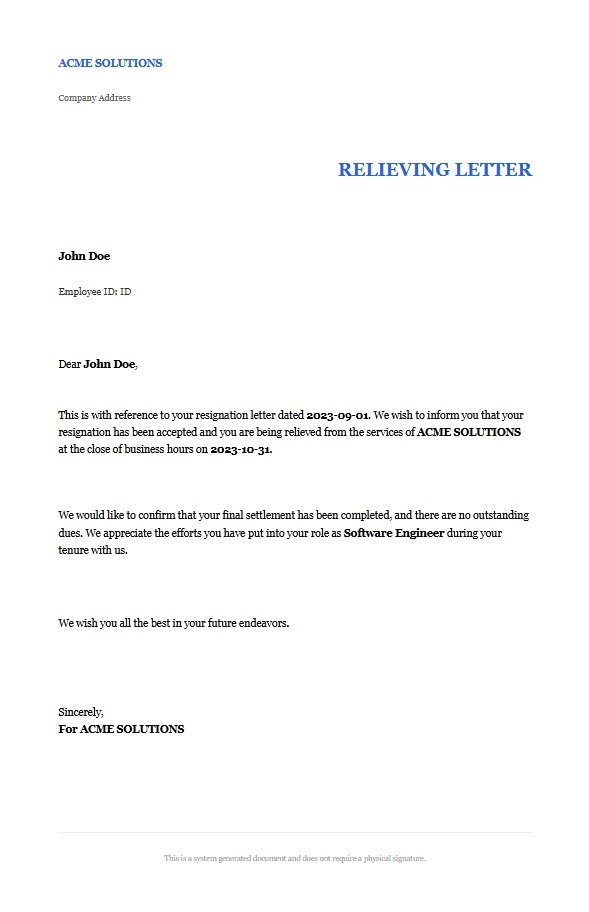
A relieving letter is a formal document issued by an employer to an employee who is departing from the organization. It serves as categorical confirmation that the employee’s resignation has been accepted and that they are officially relieved from all organizational duties and responsibilities.
The Crucial Role of a Relieving Letter
Resignation Confirmation
Formally acknowledges and accepts the employee’s departure.
Official Release
Declares the employee free from job duties as of a specific effective date.
Verified Tenure Record
Acts as an authoritative record of the employee’s start and end dates.
Career Credential
Provides a professional reference for future employers and background checks.
HR Best Practice
Always obtain a signed Undertaking from departing employees before sharing the final relieving letter.Get your Undertaking Letter signed for FREE when you generate a Relieving Letter with us.
Standard Relieving Letter Format
Solving Exit Documentation Challenges
Manual Bottlenecks
Drafting letters manually for multiple employees is slow and delays critical HR operations. Our generator cuts drafting time by 90%.
Data & Formatting Errors
Typographical blunders in relieving dates can lead to legal disputes. Automated entry ensures 100% accuracy and uniform professional formatting.
Compliance & Retrieval
Staying updated with local labor laws is hard. Our templates are vetted for compliance, and cloud storage ensures you never lose a document again.
Logistic Hurdles
Coordinating signatures after an employee leaves is a nightmare. Use digital signatures and WhatsApp delivery for instant processing.
Frequently Asked Questions
Is a relieving letter compulsory?
While not strictly mandated by law in every case, it is a critical professional document. It demonstrates a strong, transparent relationship between the employer and employee and is usually required by the employee's next employer for background verification.
Can the employer deny a relieving letter?
Employers typically cannot deny a relieving letter if the employee has completed all exit formalities, served the notice period, and cleared all dues. Denying it without valid grounds can lead to legal disputes.
How is a Release letter different from an Experience Letter?
A Relieving Letter confirms the acceptance of resignation and the specific date of release. An Experience Letter focuses more on the roles, responsibilities, and performance evaluation of the employee during their entire tenure.
Is a relieving letter a legal document?
Yes, it serves as a formal legal record confirming that the contract of employment has been successfully terminated and both parties have fulfilled their obligations.
Your Legal Compliance Superhero
Say goodbye to wrestling with Word templates. Centralize your exit paperwork with cloud storage, secure payments, and flexible delivery via WhatsApp or doorstep.